
World Cup Bracketology: How to Fill Your 2026 Bracket
World Cup bracketology guide for filling a 2026 bracket, reading the quarterfinal path, avoiding common mistakes, and separating picks from facts.
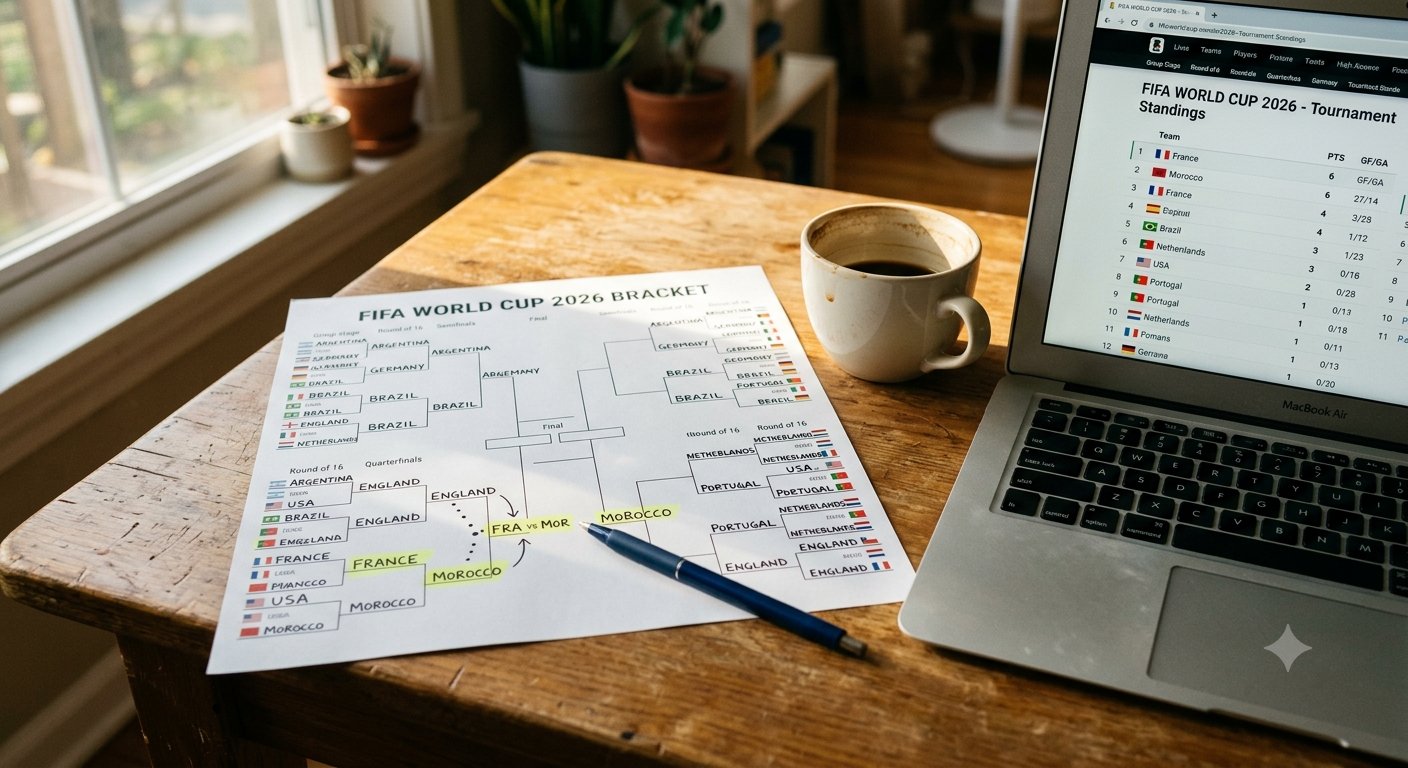
World Cup bracketology is the habit of reading a knockout bracket as a path, not just a list of matches. It asks which teams have the cleaner route, which matchups create tactical problems, which side of the bracket is overloaded, and where one upset can change the entire tournament.
That makes bracketology especially useful once the quarterfinal opponents are known. Before the bracket is filled, predictions are mostly scenario planning. After the Round of 16, the exercise becomes more concrete: you can compare real opponents, real recovery windows, and real collision points. This guide explains how to fill a World Cup 2026 bracket without pretending that prediction is certainty.
TL;DR
World Cup bracketology means analyzing the knockout path, not only picking a champion. The useful question is how each matchup changes the road to the final.
For 2026, the expanded 48-team format makes the path longer. The bracket starts with a Round of 32, so fatigue, rotation, and matchup cost matter more than in older 32-team tournaments.
As of July 10, 2026, the quarterfinal path is the right lens. Use the live World Cup 2026 bracket tracker for fixtures and scores, then use this page to interpret the path.
Good bracket picks separate facts from opinions. Official fixtures, venues, and scores are facts; path difficulty, upset probability, and champion picks are analysis.
This is for entertainment and editorial analysis only. It is not betting advice, financial advice, or a guarantee of match outcomes.
What Bracketology Means in a World Cup Context
In college basketball, bracketology often means predicting who gets into the tournament and where teams are seeded. In the World Cup, the meaning is different. Qualification has already happened, groups have already placed teams into knockout slots, and the bracket is determined by tournament rules rather than a selection committee.
World Cup bracketology is therefore about path reading. A team’s quality matters, but the path also matters: who it plays next, how physical the previous round was, where the match is staged, how many rest days are available, and whether the next opponent creates a stylistic mismatch. A stronger team can still have a harder bracket than a weaker team.
For the 2026 tournament, the format makes this more important. The expanded field adds a Round of 32 before the Round of 16, quarterfinals, semifinals, third-place match, and final. That extra knockout round creates more chances for injuries, extra time, penalties, emotional swings, and unexpected underdog runs.
Start With the Bracket Facts, Then Add Interpretation
The first rule of bracketology is to keep the source layer clean. Use the official bracket or a maintained tracker for teams, dates, venues, and scores. Then build your own analysis on top of that layer. When those two layers get mixed together, readers cannot tell what is confirmed and what is your opinion.
For the current knockout path, use the World Cup 2026 bracket template and tracker as the factual reference. It records matchups, venues, dates, and available scores. This article uses that context to explain how to think about the bracket, not to replace the live tracker.
As of the quarterfinal stage, the practical path questions are clear: France vs Morocco tests whether a tournament favorite can handle a dangerous knockout opponent; Norway vs England asks whether England can manage a tactically awkward route; Spain vs Belgium creates a heavyweight European collision; Argentina vs Switzerland tests whether Argentina can keep control against a compact opponent.
How to Fill a World Cup 2026 Bracket Step by Step
The best way to fill a bracket is not to start with the champion and force every earlier pick to fit that story. Start from the earliest remaining round, decide each matchup based on evidence, and only then look at the final path. This prevents one favorite from pulling your entire bracket into a biased shape.
Step | What to Decide | Practical Question |
1 | Confirm the factual bracket | Are the teams, venues, and dates current? |
2 | Rate each matchup | Which team has the better tactical fit, form, and rest profile? |
3 | Mark upset zones | Which favorite is most vulnerable to style, fatigue, or pressure? |
4 | Advance winners round by round | Does the next matchup change your view of the pick? |
5 | Re-check the final path | Did you pick a champion, or did you actually build a path? |
After you fill one version, make a second version with only one assumption changed. For example, flip one quarterfinal upset and see how the semifinal path changes. This is the fastest way to understand why bracketology is useful: one result rarely changes only one line; it changes the opponents, rest pattern, and tactical landscape for the next round.
A practical bracket should also record confidence, not only winners. Mark one pick as “high confidence,” one as “lean,” and one as “upset watch.” This gives you a better post-match review because you can tell whether your process was wrong or whether football variance simply beat a reasonable pick. If you predicted a favorite with low confidence and the opponent won on penalties, the bracket may not have been poor; it may have identified the right danger zone.
Finally, keep notes beside each pick. A one-line note such as “short rest after extra time,” “set-piece mismatch,” or “favorite likely controls midfield” makes the bracket more useful later. Without notes, you only know whether you were right. With notes, you know why you were right or wrong, which is the real value of bracketology.
Reading the Quarterfinal Path
Quarterfinal bracketology is different from pre-tournament prediction. At this point, reputation matters less than survival. Every remaining team has already handled pressure, and the bracket has enough data to support more specific analysis.
France vs Morocco is a high-ceiling matchup because it combines tournament favorite pressure with underdog volatility. Morocco’s path matters because penalty resilience and defensive organization can travel well in knockout football. France’s path matters because favorites are judged not only by whether they win, but by whether they control the match without burning too much energy before the semifinal.
Norway vs England is a different type of bracketology test. England’s knockout path has already carried emotional and tactical cost, while Norway’s route changes the assumptions people may have made before the tournament. The question is not simply “who is better on paper?” It is whether England can impose control early enough to keep the match from becoming a late-game variance contest.
Spain vs Belgium is the cleanest heavyweight-style quarterfinal on the board. Both teams can create a plausible champion narrative, which makes this a dangerous place for overconfidence. When two high-quality sides meet before the semifinal, the winner may gain credibility but also pay a physical and emotional price.
Argentina vs Switzerland is a classic path-management matchup. Argentina brings the bigger global expectation, but Switzerland represents the type of opponent that can narrow a game, reduce open space, and make the favorite solve repeated possession problems. In bracket terms, the key question is whether Argentina wins efficiently or gets dragged into a match that affects the semifinal.
The quarterfinals also change how you think about the final. At the start of the knockout stage, it is tempting to imagine a clean favorite-versus-favorite final. By the quarterfinals, the more useful question is which team can survive two different tactical problems in a row. A side that looks dominant in one matchup may face a completely different test in the semifinal, especially if the next opponent presses higher, defends deeper, or forces a slower tempo.
This is why bracketology should not reduce every path to team ranking. A ranking tells you who appears strongest in isolation. A bracket tells you who must beat whom, in what order, with what recovery window, and under what pressure. The quarterfinal stage is where those differences become visible.
A Simple Bracketology Scoring Framework
A useful bracketology model does not need to be complicated. For an editorial bracket, five categories are enough: team quality, matchup fit, current form, rest and travel, and variance risk. Give each category a simple score from 1 to 5, then write one sentence explaining the score. The sentence matters more than the number because it forces the analysis to be explicit.
Factor | What It Measures | Why It Matters |
Team quality | Baseline talent, depth, and tournament experience | Prevents one-game narratives from overwhelming the full picture |
Matchup fit | How styles interact | Explains why a strong team may still dislike a specific opponent |
Current form | Recent performance and confidence | Captures what has changed since the group stage |
Rest and travel | Recovery time and location burden | Matters more as the knockout rounds compress |
Variance risk | Penalties, set pieces, injuries, and game state volatility | Identifies where a favorite can lose without being outplayed |
This framework is intentionally lightweight. It is not trying to simulate the tournament. It is trying to make your reasoning visible. If two people disagree on a pick, the scores reveal where they disagree: one may rate team quality higher, while the other sees a matchup problem or fatigue risk.
Common Bracketology Mistakes
The most common mistake is picking names instead of paths. A famous team can have a difficult opponent, short rest, a hostile venue atmosphere, or a matchup that exposes its weaknesses. Bracketology should account for those conditions rather than treating the crest as the prediction.
A second mistake is overreacting to the last result. A 3–0 win can hide poor finishing from the opponent; a 1–0 win can hide excellent control. Scores matter, but they are not the whole story. If you only sort teams by the previous scoreline, your bracket becomes a highlight-reel reaction rather than an analysis.
A third mistake is ignoring the next round. A quarterfinal pick should be evaluated partly by what it creates afterward. If a team can win a quarterfinal only through extra time, injury risk, and emotional exhaustion, that matters for the semifinal. The bracket is a chain, not four isolated games.
A fourth mistake is treating every upset as equally likely. Underdog wins happen for different reasons. Some are tactical, some are emotional, some are driven by penalties, and some come from a favorite losing control after an early goal. A good bracket does not simply sprinkle upsets to look bold. It identifies where the structure of the match makes an upset plausible.
A fifth mistake is forgetting that a bracket is not a power ranking. If your top four teams are all on the same side of the bracket, they cannot all reach the semifinals. That sounds obvious, but it is one of the most common prediction errors: people pick the teams they like, then notice too late that the bracket forces them to eliminate each other.
How to Use Bracketology in Office Pools and Group Chats
For office pools, group chats, and fan contests, bracketology has a social function as well as an analytical one. It gives you a reason for the pick you are making. Instead of saying “I like England,” you can say “I like England if they control the first hour and avoid turning the match into a late transition game.” That kind of explanation makes the bracket more interesting even when the pick misses.
The best office-pool approach is to balance safety and differentiation. If every participant picks the same favorite, you do not gain much by following the crowd. But if you force too many underdogs into the semifinal, the bracket becomes fragile. One sensible method is to keep most favorites early, choose one credible upset path, and avoid making the champion pick depend on three unlikely events in a row.
For group chats, keep a screenshot or PDF version of your bracket and update it after each round. The update process matters because it shows how the path changed. A wrong pick is not the end of the exercise; it is the moment to ask what the new bracket now favors.
Where Predictions Fit: Picks, Pools, and FloatCup
Prediction content belongs in a separate layer from bracket tracking. If you want a broader entertainment guide, use the World Cup 2026 predictions and bracket picks. That article can rank champion narratives, upset angles, and office-pool style choices without turning this tutorial into a prediction board.
If you are following the tournament through calendar reminders, the bracket can also become a planning tool. A live calendar does not tell you who will win, but it does keep the next match in front of you at the right time. That is where FloatCup’s World Cup 2026 calendar subscription fits: it keeps the schedule layer updated while you use bracketology for interpretation.
The key distinction is simple. The bracket tracker tells you what is scheduled or completed. Bracketology tells you what the path may mean. Predictions tell you what you think will happen. Keeping those three layers separate makes the article more useful and more trustworthy.
Conclusion
World Cup bracketology is most valuable when the bracket is real enough to analyze but not finished enough to be obvious. The 2026 quarterfinal stage is exactly that moment. The Round of 32 and Round of 16 have already changed the field, and the remaining path is now concrete enough to compare matchups, fatigue, and collision points.
Use the official bracket or the live tracker for facts. Use this guide to think through path difficulty, upset zones, and champion routes. And keep the entertainment disclaimer in place: a bracket can be smart, but football does not owe anyone a clean prediction.
FAQ
What does World Cup bracketology mean?
World Cup bracketology means analyzing the knockout bracket as a path. It looks at matchups, rest, venue context, upset risk, and future opponents rather than only picking a champion.
How is World Cup bracketology different from predictions?
Predictions focus on what you think will happen. Bracketology focuses on how the bracket is structured and why one path may be easier or harder than another. A good bracketology article can explain path difficulty without making a hard champion pick.
Should I fill my bracket from the champion backward?
Usually, no. It is better to fill the bracket round by round, starting with the earliest remaining matchups. That reduces favorite bias and forces you to evaluate each opponent before choosing a champion.
Is this betting advice?
No. This article is for entertainment and editorial analysis only. It should not be used as betting advice or as a guarantee of match outcomes.
Where can I get a printable World Cup 2026 bracket?
Use the World Cup 2026 bracket template and tracker. It includes the bracket structure, match dates, venues, and downloadable tracker assets.
Related Reading
World Cup Bracket 2026: Template, Tracker & PDF — the factual bracket tracker and downloadable assets.
World Cup 2026 Predictions & Bracket Picks — entertainment-focused prediction angles.
FloatCup: Subscribe to the World Cup 2026 Calendar in One Click — calendar reminders and match-time updates.
Get automation tips for your workflow
Weekly insights for non-technical professionals. No spam ever.