
World Cup Bracket 2026: Template, Tracker & PDF
World Cup bracket 2026 guide with knockout matchups, dates, venues, scores, printable tracker assets, and links to group standings and predictions.
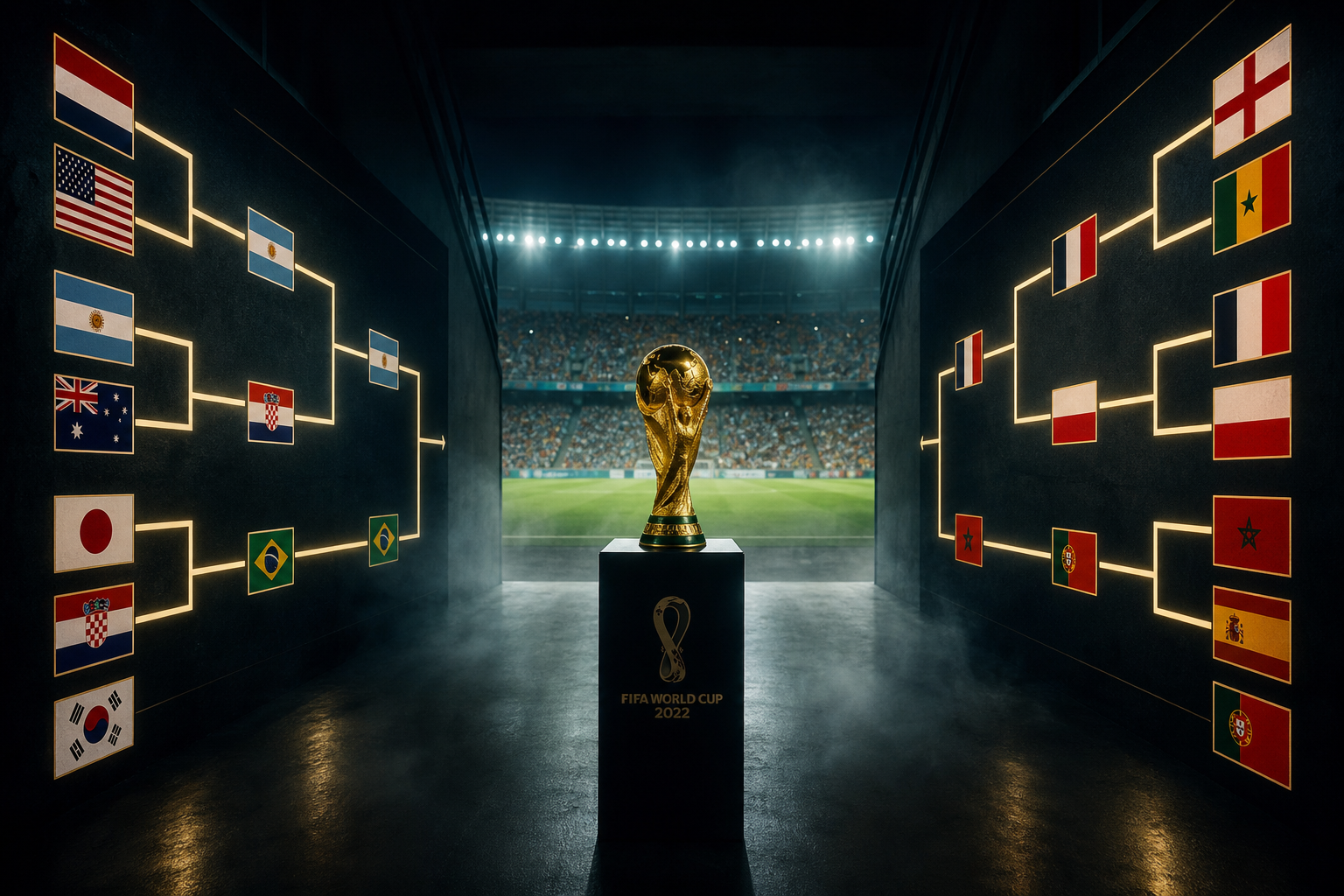
The World Cup 2026 bracket is where the group stage becomes a single-elimination path. With 48 teams, twelve groups, and a Round of 32, the bracket is larger than older World Cup templates and more useful as a live tracker. This page gives you the knockout matchups, dates, venues, available scores, and downloadable assets for following the tournament from the Round of 32 to the final.
As of July 8, 2026, the group stage and Round of 32 are complete, and the bracket has moved into the quarterfinal stage. Use this page together with the World Cup 2026 groups and standings hub to understand how each team reached its knockout slot.
Source note: Matchups, dates, venues, and scores are attributed to the FIFA Official Bracket, with group-stage placement context connected to the World Cup 2026 groups and standings hub.
TL;DR
The 2026 World Cup bracket starts with a Round of 32 because the tournament expanded to 48 teams.
The knockout path is filled from final group positions, so the World Cup 2026 groups and standings page is the upstream source for bracket placement.
This article includes a bracket preview image and a printable PDF tracker so the title promise — Template, Tracker & PDF — matches the article body.
For prediction content, use World Cup 2026 Predictions & Bracket Picks. For process and scoring strategy, use World Cup 2026 Bracketology How-To.
Download the World Cup 2026 Bracket Template and Tracker

Download the printable World Cup 2026 bracket tracker PDF
Open the PNG bracket preview
The PNG is designed for quick article preview and sharing. The PDF is designed as a printable tracker for scores, winners, and office-pool notes. It avoids official FIFA marks and uses neutral editorial labeling.
How to Read the 2026 World Cup Bracket
A bracket shows how winners move from one knockout round into the next. In 2026, the first knockout round is the Round of 32, followed by the Round of 16, quarterfinals, semifinals, third-place match, and final. The extra round means more teams survive the group stage, and it gives third-place qualifiers a real chance to reshape the path.
The most important workflow is upstream first: confirm the final group tables, then fill the bracket. A group winner, runner-up, or third-place qualifier can land in a very different path depending on the official allocation. That is why this bracket page keeps linking back to World Cup 2026 groups and standings, where points, tiebreakers, and advancement status are explained.
Round of 32 Results
Match | Date | Venue | Fixture | Score / Status | Winner |
R32-1 | June 29, 2026 | Los Angeles Stadium, Los Angeles | South Africa vs Canada | Canada 1–0 South Africa | Canada |
R32-2 | June 30, 2026 | Houston Stadium, Houston | Brazil vs Japan | Brazil 2–1 Japan | Brazil |
R32-3 | June 30, 2026 | Boston Stadium, Boston | Germany vs Paraguay | 1–1 (Paraguay won 4–3 on penalties) | Paraguay |
R32-4 | June 30, 2026 | Monterrey Stadium, Monterrey | Netherlands vs Morocco | 1–1 (Morocco won 3–2 on penalties) | Morocco |
R32-5 | July 1, 2026 | New York/New Jersey Stadium, New Jersey | France vs Sweden | France 3–0 Sweden | France |
R32-6 | July 1, 2026 | Dallas Stadium, Dallas | Côte d'Ivoire vs Norway | Norway 2–1 Côte d'Ivoire | Norway |
R32-7 | July 1, 2026 | Mexico City Stadium, Mexico City | Mexico vs Ecuador | Mexico 2–0 Ecuador | Mexico |
R32-8 | July 2, 2026 | Atlanta Stadium, Atlanta | England vs Congo DR | England 2–1 Congo DR | England |
R32-9 | July 2, 2026 | San Francisco Bay Area Stadium, San Francisco | USA vs Bosnia and Herzegovina | USA 2–0 Bosnia and Herzegovina | USA |
R32-10 | July 2, 2026 | Seattle Stadium, Seattle | Belgium vs Senegal | Belgium 3–2 Senegal | Belgium |
R32-11 | July 3, 2026 | Toronto Stadium, Toronto | Portugal vs Croatia | Portugal 2–1 Croatia | Portugal |
R32-12 | July 3, 2026 | Los Angeles Stadium, Los Angeles | Spain vs Austria | Spain 3–0 Austria | Spain |
R32-13 | July 3, 2026 | BC Place Vancouver, Vancouver | Switzerland vs Algeria | Switzerland 2–0 Algeria | Switzerland |
R32-14 | July 4, 2026 | Miami Stadium, Miami | Argentina vs Cabo Verde | Argentina 3–2 Cabo Verde | Argentina |
R32-15 | July 4, 2026 | Kansas City Stadium, Kansas City | Colombia vs Ghana | Colombia 1–0 Ghana | Colombia |
R32-16 | July 4, 2026 | Dallas Stadium, Dallas | Australia vs Egypt | 1–1 (Egypt won 4–2 on penalties) | Egypt |
Source: FIFA Official Bracket
The Round of 32 is the biggest structural change for 2026 bracket tracking. It gives group winners one more elimination match to survive and gives strong third-place teams a chance to become dangerous quickly. Brazil, France, England, Spain, Argentina, Belgium, USA, Portugal, and Colombia all moved the bracket into a contender-heavy middle phase, while Paraguay and Morocco pulled off penalty-shootout upsets over Germany and Netherlands respectively.
Round of 16 Results
Match | Date | Venue | Fixture | Score / Status | Winner |
R16-1 | July 5, 2026 | Philadelphia Stadium, Philadelphia | Paraguay vs France | France 1–0 Paraguay | France |
R16-2 | July 5, 2026 | Houston Stadium, Houston | Canada vs Morocco | Morocco 3–0 Canada | Morocco |
R16-3 | July 6, 2026 | New York/New Jersey Stadium, New Jersey | Brazil vs Norway | Norway 2–1 Brazil | Norway |
R16-4 | July 6, 2026 | Mexico City Stadium, Mexico City | Mexico vs England | England 3–2 Mexico | England |
R16-5 | July 7, 2026 | Dallas Stadium, Dallas | Portugal vs Spain | Spain 1–0 Portugal | Spain |
R16-6 | July 7, 2026 | Seattle Stadium, Seattle | USA vs Belgium | Belgium 4–1 USA | Belgium |
R16-7 | July 8, 2026 | Atlanta Stadium, Atlanta | Argentina vs Egypt | Argentina 3–2 Egypt | Argentina |
R16-8 | July 8, 2026 | BC Place Vancouver, Vancouver | Switzerland vs Colombia | 0–0 (Switzerland won 4–3 on penalties) | Switzerland |
Source: FIFA Official Bracket
The Round of 16 produced the tournament's biggest upsets. Norway knocked out Brazil 2–1, Belgium crushed the United States 4–1, and Morocco swept Canada 3–0. England survived a five-goal thriller against Mexico, while Spain edged Portugal 1–0 in a tight Iberian derby. Argentina needed all of a 3–2 win over Egypt, and Switzerland held Colombia to a penalty shootout victory. The quarterfinal field is wide open.
Quarterfinal Fixtures
Match | Date | Venue | Fixture | Score / Status | Winner |
QF-1 | July 10, 2026 | MetLife Stadium, New York/New Jersey | France vs Morocco | Scheduled | Winner pending |
QF-2 | July 10, 2026 | AT&T Stadium, Dallas | Norway vs England | Scheduled | Winner pending |
QF-3 | July 11, 2026 | Mercedes-Benz Stadium, Atlanta | Spain vs Belgium | Scheduled | Winner pending |
QF-4 | July 11, 2026 | SoFi Stadium, Los Angeles | Argentina vs Switzerland | Scheduled | Winner pending |
Source: FIFA Official Bracket
The quarterfinals are where the bracket becomes less about qualification labels and more about path cost. France vs Morocco is the highest-ceiling football matchup, while Spain vs Belgium carries significant European heavyweight weight. Argentina vs Switzerland brings a South American path test, and Norway vs England gives the lower half another tactical contrast.
Semifinals, Third-Place Match, and Final
Round | Date | Venue | Fixture | Score / Status | Winner |
Semifinal | July 15, 2026 | AT&T Stadium, Dallas | Winner QF-1 vs Winner QF-2 | Scheduled | Winner pending |
Semifinal | July 16, 2026 | Mercedes-Benz Stadium, Atlanta | Winner QF-3 vs Winner QF-4 | Scheduled | Winner pending |
Third-place match | July 19, 2026 | Hard Rock Stadium, Miami | Loser SF-1 vs Loser SF-2 | Scheduled | Medal match pending |
Final | July 20, 2026 | MetLife Stadium, New York/New Jersey | Winner SF-1 vs Winner SF-2 | Scheduled | Champion pending |
Source: FIFA Official Bracket
The final stretch is still fixture-dependent because the quarterfinal winners determine the semifinal paths. The most important publishing rule for this section is to update the winner labels as soon as each match ends, while keeping the final venue and date stable.
What the Current Bracket Says About the Tournament
The bracket is no longer just a printable worksheet. By July 8, it has become the clearest summary of how the tournament actually changed shape after the group stage. The group tables explain who advanced, but the bracket explains the cost of each finish. A team that won its group did not simply receive a badge of honor; it received a specific opponent, a venue assignment, a rest window, and a possible route into the semifinal side of the draw.
The most important pattern is that the Round of 32 added one more pressure point before the familiar knockout rounds. In a 32-team World Cup, group winners moved straight into the Round of 16. In 2026, even a strong group winner had to survive an additional elimination match. That extra match increased variance. It gave third-place teams a genuine chance to damage a favorite, and it forced teams with title ambitions to manage energy earlier than usual.
For readers using this page as a tracker, the practical question is not only “who won?” It is “what did that win do to the path?” France’s early route, for example, matters because each win changes the quality of the next opponent and the recovery profile before the quarterfinal. The England path matters because every narrow knockout win changes both public expectation and rest pressure. Morocco, Norway, Belgium, Argentina, Spain, and Switzerland matter because their routes affect the heavyweight collision points in the bracket.
That is why a good bracket article needs match tables and narrative. Tables make the bracket scannable. Narrative explains why a result mattered. A one-goal win, a penalty advance, and a routine two-goal result all occupy one row in a bracket, but they carry different implications for fatigue, confidence, rotation, and opponent preparation.
How to Use This Bracket Tracker
Use the tracker in three passes. First, scan the round tables to see which teams have already advanced and which fixtures are still scheduled. Second, compare the current path with the final group standings to understand why each team landed in that slot. Third, use the downloadable PDF if you need a printable office-pool or watch-party version.
The article table is best for live reading because it includes match dates, venues, scores, and winners in one place. The PNG preview is best for a quick visual overview. The PDF is best for printing, marking winners, and writing notes during matches. These three assets serve different reader jobs, which is why they all belong on the same canonical bracket page instead of being split across separate posts.
If you are following one team, start with that team’s most recent result and read forward. If you are following the whole tournament, start with the Round of 32 and move down the page. If you are managing an office pool, use the prediction and bracketology links after reviewing the factual tracker. The tracker should remain the factual base; picks and scoring logic belong in the prediction and how-to articles.
The key advantage of this workflow is that it prevents bracket confusion. Many readers search for “World Cup bracket” after seeing a single result. They do not necessarily know whether that result changed the Round of 16, quarterfinals, or semifinal path. A round-by-round tracker gives them the answer without forcing them to reconstruct the tournament from scattered match reports.
Round-by-Round Implications
The Round of 32 tested whether group performance translated into knockout control. Some teams advanced cleanly, while others needed narrow margins or penalties. That matters because a team that survives through penalties may still advance, but the physical and emotional cost can influence the next round.
The Round of 16 was the first point where the bracket started to look like a traditional World Cup knockout phase. Favorites and host narratives became easier to compare because the field was smaller. At that stage, the question shifted from “who qualified?” to “who has the path quality to keep going?” A team can look dominant in the group stage and still face a difficult bracket assignment immediately after.
The quarterfinals are the first true path-quality checkpoint. Every remaining team has already survived at least two knockout pressure moments or a demanding sequence from group play into elimination matches. A quarterfinal table should therefore include not only the fixture but also the date and venue. Rest, travel, and venue familiarity can become meaningful when teams are playing every few days.
The semifinals and final require a different reading style. Once the tournament reaches that stage, the exact matchup is less predictable until the quarterfinals are complete, but the venue and calendar are already part of the planning problem. Fans buying tickets, setting reminders, organizing watch parties, or running content workflows need those fixed dates even before the teams are known.
Source Map for Bracket Claims
The bracket tables use three types of claims. The first type is structural: the tournament has a Round of 32, then Round of 16, quarterfinals, semifinals, third-place match, and final. The second type is factual: each row lists a match date, venue, fixture, score, and winner where available. The third type is interpretive: narrative sections explain why a path is easy, difficult, or commercially important for readers.
Structural and factual claims are attributed to the FIFA Official Bracket source listed under each knockout table. Group placement context is connected to the World Cup 2026 groups and standings article because that page explains how the bracket slots were earned. Interpretive claims are framed as editorial analysis rather than official tournament statements.
This distinction matters for trust. Readers should be able to separate what the official bracket says from what this article concludes about path difficulty. For example, a table can say that United States vs England is scheduled at AT&T Stadium. The analysis can then explain why that matchup matters for US readers, but it should not present audience interest or path difficulty as an official FIFA claim.
Asset Notes: PNG Preview and Printable PDF
The bracket preview image is included for quick scanning. It is not meant to replace the full match tables because a single image cannot carry every venue, score, and source note without becoming unreadable on mobile. Its job is to make the page visually useful and to satisfy the reader expectation created by a “template and tracker” title.
The PDF is included for printing. A printable bracket should leave room for handwriting, because many readers use brackets during office pools, classroom activities, family watch parties, or internal content planning. The PDF asset is neutral: it does not use official FIFA marks, does not imply official affiliation, and does not turn predictions into betting advice.
The article itself remains the canonical tracker because Markdown tables are easier to update, search, and quote. The assets are supporting formats. That separation keeps the content useful for readers while reducing the risk that an image-only bracket becomes stale faster than the article.
Bracket Predictions and Bracketology
This page is the tracker, not the prediction model. If you want a forward-looking view of likely winners, use World Cup 2026 Predictions & Bracket Picks. If you want to understand how to fill a pool sheet, score picks, or think about path difficulty, use World Cup 2026 Bracketology How-To.
For office pools, label prediction content clearly as entertainment rather than betting advice. The bracket tracker should stay factual: match, date, venue, score, winner, and next path.
Calendar and Reminder Workflow
A bracket is a map, but a calendar is what makes the map actionable. Once the Round of 32 begins, matches arrive quickly, and it is easy to miss a kickoff if you are following multiple teams or time zones. The World Cup schedule gives the full list; FloatCup turns that list into reminders.
If you use Floatboat, you can attach lightweight workflows to matches: pre-match briefs, watch-party notes, post-match recap drafts, or office-pool updates. If you do not use Floatboat, a standard calendar subscription still solves the main problem: correct match times across EDT, CDT, PDT, and your local timezone if you travel.
Related Reading
World Cup 2026 Groups & Standings — fill the bracket from final group tables
World Cup 2026 Draw: Rules, Results & Groups — understand how paths begin
World Cup 2026 Predictions & Bracket Picks — P07 prediction and pick workflow
World Cup 2026 Bracketology How-To — P21 bracketology method and office-pool logic
FloatCup: Subscribe to World Cup 2026 Calendar in One Click — reminders for knockout matches
Conclusion
The World Cup 2026 bracket is larger, faster, and more volatile than older 32-team tournament templates. The Round of 32 gives more teams a route into the knockout phase, but it also creates one extra elimination hurdle for favorites. That makes a live tracker more useful than a static bracket image.
Use this page as the bracket hub: download the tracker, check the current match table, then move between the groups page, prediction page, and bracketology guide depending on whether you need facts, picks, or method.
FAQ
What is a World Cup bracket?
A World Cup bracket is the knockout-stage map showing how teams advance from the group stage through the Round of 32, Round of 16, quarterfinals, semifinals, third-place match, and final.
Does the 2026 World Cup have a Round of 32?
Yes. The expanded 48-team format includes a Round of 32 before the Round of 16.
Where can I download a World Cup 2026 bracket PDF?
You can download the printable World Cup 2026 bracket tracker PDF from the asset section near the top of this page.
When can I fill out the official bracket?
You can fill a prediction bracket before the tournament, but the official knockout bracket can only be filled after group-stage results determine placements.
Is a bracket prediction betting advice?
No. Bracket predictions on this page are for entertainment purposes only, not betting advice.
Related Articles
Get automation tips for your workflow
Weekly insights for non-technical professionals. No spam ever.