
HTML vs Markdown for AI Output
HTML vs Markdown for AI output depends on the job: human-facing artifacts need clarity, while internal agent work needs efficiency.
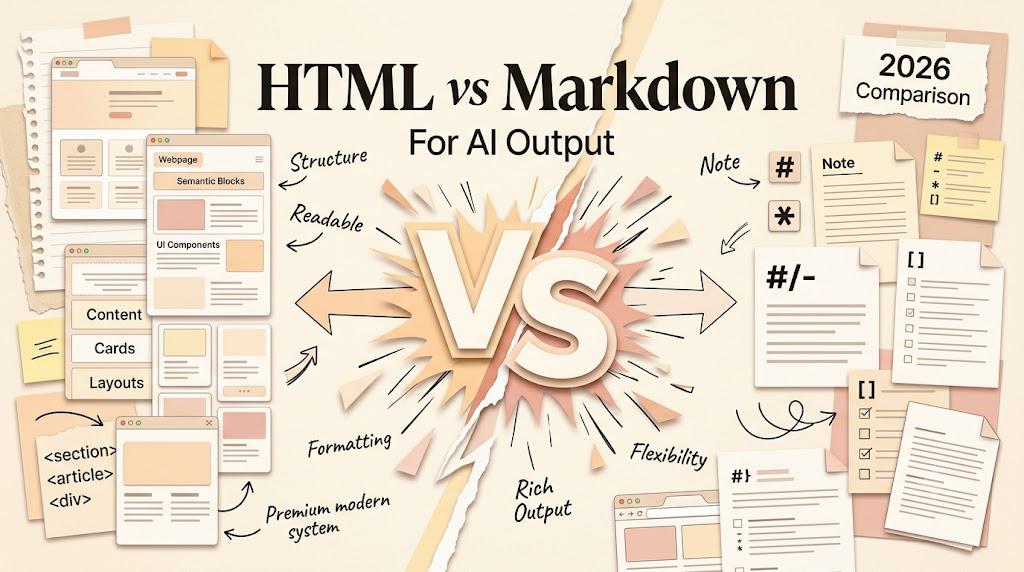
Hey, It's Me. Nova. The question I keep getting — from friends, in DMs, in comments — is some version of: should I be asking my AI agent for HTML instead of Markdown now?
The answer changes based on one variable: what you're actually using the output for. Not which format is "better" in the abstract. Not which one is trendier this month. The job the output needs to do. That's the whole framework for thinking about HTML vs Markdown for AI output, and I'm going to walk through exactly how I apply it.
Quick Decision Table
Before I get into the reasoning, here's the cheat sheet I keep in my head. Four scenarios, two format options, one recommendation each.
Scenario | Markdown | HTML |
|---|---|---|
Internal notes (personal, never shared) | ✅ Use Markdown. Lightweight, editable, fast. | Overkill for this job. |
Agent-to-agent (output feeds another AI step) | ✅ Use Markdown. Token-efficient, parseable. | Adds cost with no audience to see it. |
Human-facing reports (someone reads and acts on this) | Works, but limited visual structure. | ✅ Use HTML. Hierarchy, color, navigation help. |
Shareable artifacts (published, reused, or presented) | Hard to style, platform-dependent rendering. | ✅ Use HTML. Self-contained, portable, visual. |
That's the short version. The rest of this article is the "why" behind each cell.
Use Markdown When the Output Is Internal, Editable, or Versioned
Markdown is not going away. I want to be clear about that because the "HTML is the new Markdown" conversation sometimes sounds like Markdown is broken. It's not.
Here's where Markdown for AI agents is still the right default:
Anything that gets version-controlled. If the output goes into a Git repo — READMEs, changelogs, technical specs, CLAUDE.md files — Markdown diffs are clean and readable. HTML diffs are noise. I've tried reviewing HTML diffs in pull requests and it's like reading a redlined legal document through a kaleidoscope. Not useful.
Agent-to-agent handoffs. When one AI step produces output that another AI step consumes, the human never sees it. No human eyes, no need for visual hierarchy. Markdown keeps token costs down and parsing simple. The Markdown Guide puts this well: the format was designed so that even the raw source is readable as-is. For machine consumption, that readability-in-source quality doesn't matter — but the token efficiency does.
Quick notes and drafts. If I'm asking Claude to brainstorm ten ideas or outline a project, Markdown is faster to generate, easier to edit, and instantly readable in any text editor. I don't need collapsible sections for a list I'll read once and delete.
The pattern: when the output is meant to be edited, versioned, or consumed by machines, Markdown wins. That hasn't changed.
Use HTML When Humans Need to Inspect, Compare, or Interact
Reports, reviews, dashboards, specs, prototypes
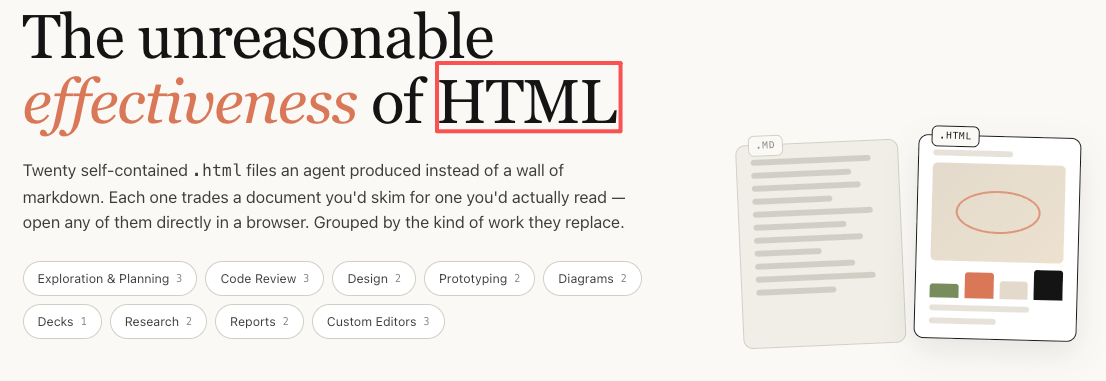
This is where the shift is real. When Thariq Shihipar from Anthropic's Claude Code team published his companion examples of AI-generated HTML, the thing that clicked for me wasn't the technical argument — it was opening the same implementation plan in both formats and feeling the difference.
The Markdown version was fine. The HTML version had a sticky navigation sidebar, color-coded priority levels, and collapsible sections. I read the whole thing. I usually don't.
Here's how I think about when HTML artifacts earn their place:
Reports and reviews. Anything where a human needs to scan, compare sections, or jump between parts of the document. HTML gives you anchor links, table of contents, visual grouping. A quarterly review in Markdown is a scroll. The same review in HTML is a dashboard.
Code reviews and PR summaries. Thariq's examples included PR reviews with inline diff annotations and color-coded severity. That's information architecture that Markdown literally cannot express — there's no syntax for "put these two things side by side and color the left one red."
Prototypes and mockups. If your agent can produce a working HTML prototype — a landing page, a form, a dashboard layout — that's a deliverable, not a document. You can open it in a browser, share it with a client, iterate on it. Markdown can't do that.
Shareable artifacts. An HTML file with inline CSS travels well. Email it, open it on any device, no renderer required. Markdown needs a rendering engine to look like anything — and which engine matters, because GitHub's Markdown rendering is not the same as Obsidian's, which is not the same as Notion's.
The pattern: when the output is meant to be read, compared, or acted on by a human, HTML earns the extra weight.
Token Cost and Maintenance Trade-Offs
I'm not going to say "it depends" and leave it there. But I'm also not going to throw out a specific multiplier, because the numbers I've seen vary too much to repeat honestly.
Here's what I can say with confidence:
HTML generally costs more tokens than Markdown for the same content. The structure and styling tags — <div>, <style>, <section>, CSS properties — add up. That's the direction.
Longer outputs amplify the difference. A three-paragraph summary? The token gap between Markdown and HTML is negligible. A 20-section implementation plan with tables, color coding, and navigation? The gap is meaningful. The more visual structure the HTML needs, the wider the cost spread.
The honest way to check is to test it yourself. Run the same prompt in both formats and compare token counts in your chosen model. I checked Anthropic's API pricing documentation to make sure I understood how output tokens get billed — it's per-token on the output side, so longer HTML outputs do cost proportionally more. But for most solo operators generating individual deliverables, the difference is small enough to be worth the readability gain.
There's also a maintenance angle. Markdown files are easy to hand-edit. HTML files — especially ones with embedded CSS — are harder to tweak without breaking the layout. If you need to make a quick change to a document after the agent generates it, Markdown is more forgiving.
Fit matters more than features. Choose based on whether you'll be editing the output (Markdown) or consuming it as-is (HTML).
A Decision Framework for Solo Operators
Ask yourself: what does my workflow actually look like on a Tuesday?
If you're a solo operator — content, strategy, delivery, all of it — here's the framework I use. Four questions, asked in order:
Who reads this output? If it's just you, or another agent in a chain → Markdown. If a human client, collaborator, or audience reads it → consider HTML.
Will it be edited after generation? If yes → Markdown. Much easier to revise in any text editor. If it's a finished deliverable → HTML holds its formatting better.
Does it need visual structure? If it's a flat list, outline, or paragraph → Markdown is fine. If it needs tabs, color coding, navigation, or side-by-side comparison → HTML.
Will it be reused or templated? If you produce the same type of output repeatedly and want visual consistency, tools like Claude Artifacts or local-first agentic HTML editors like html-anything can template the process. One-off requests don't need that infrastructure.
The default I've landed on: draft and iterate in Markdown, then convert or refine to HTML when delivering to humans. This hybrid workflow means I get Markdown's editability during the thinking phase and HTML's readability for the shipping phase. I've been using this for a few weeks now and it feels right — though I'll know more once I've hit more edge cases.

FAQ
Is HTML better than Markdown for AI output?
Neither is universally better. HTML is better when the output needs visual hierarchy, interactivity, or platform-independent styling — reports, reviews, dashboards, prototypes. Markdown is better when the output needs to be lightweight, editable, version-controlled, or machine-consumed. The question isn't which format is superior. It's which format serves the job.
When should agents still use Markdown?
When the output feeds back into a system rather than being read by a human. Agent-to-agent workflows, Git-tracked documentation, config files, internal notes, and anything that will be hand-edited after generation. Markdown's token efficiency and diff-friendliness make it the right tool for these jobs.
Does HTML cost more tokens than Markdown?
Generally yes, because of the added structure and styling tags. The gap is small for short outputs and grows with document complexity. I'd recommend running the same prompt in both formats and checking token counts in your model's usage dashboard rather than relying on generalized estimates. The exact ratio depends on how much visual structure the HTML needs.

Can AI generate both Markdown and HTML in one workflow?
Yes — and this is the hybrid approach I'd recommend. Draft in Markdown during the thinking and iteration phase, then ask the agent to convert or regenerate as HTML when the output needs to be delivered, presented, or shared. Most capable models handle this conversion well. The rule I use: Markdown for process, HTML for delivery.
What about workspace tools like Claude Artifacts or ChatGPT Canvas?
Both make AI-generated HTML more accessible — Artifacts renders HTML directly in the Claude interface, and Canvas provides a side-panel editing workspace. They lower the barrier to working with HTML output. But they have real limits worth knowing: outputs are session-bound and not always easy to take with you across platforms. Template and reuse capabilities are limited compared to local tools or custom workflows. They're great for single-session work; they're less great for repeatable, cross-platform publishing. That trade-off fits the broader pattern of this article — the right tool depends on the workflow, not the format in isolation.
That's the framework. It's not complicated, but it took me a while to land on something this clear. The real difference isn't HTML vs Markdown — it's knowing which one matches the job you're doing right now. That one small piece figured out.
Previous Posts:
• HTML-Anything Review: Can AI Turn HTML Into Real Deliverables? — I tested whether html-anything actually turns the "HTML is the new Markdown" idea into a usable workflow.
• Claude Code vs Chrome Extensions: Which Workflow Actually Saves Time? — Not every AI workflow needs a coding agent; here's where browser-native tools fit better.
• Workspace Agents vs Chat Assistants: Why the Difference Matters — The jump from chat responses to reusable work artifacts changes how AI output gets used.
• AI Workspace Agents: Why Solo Operators Need More Than Chat Windows — Rich AI output starts making more sense once the workspace itself becomes part of the workflow.
Get automation tips for your workflow
Weekly insights for non-technical professionals. No spam ever.